
Executive coach, author and Club Member Tish Squillaro has a no-nonsense leadership style and deep emotional intelligence that have helped shape boardrooms and businesses alike. As the founder and CEO of Candor Consulting, she brings clarity, confidence and compassion to her clients, helping them lead better by first understanding themselves.
In this episode of A Life Well-Lived, Tish opens up about the power of self-awareness and the value of navigating tough conversations with honesty, in leadership and in life. Her story is equal parts strategy and heart, a reminder that living well is not just about success. It is about intention, connection and showing up fully in every chapter.

Listen on: YouTube · Spotify · Apple Podcasts
From Brooklyn to Penn to Doggy World
Tish put herself through school and went to the University of Pennsylvania intending to become a lawyer, having worked in a law firm straight out of high school. Getting into Penn at all meant ignoring the people who told her it could not be done.
“Someone once told me, ‘You can’t go to an Ivy League school, Tish. You’re from Brooklyn.’ I said, ‘Oh, really?’ So I worked my way in. I never take no for an answer.”
Once there, she discovered she did not like law, switched to business classes, and took to heart a marketing professor’s advice: find something that already exists and do it a little differently. With a new puppy named Barney and the question of who would look after him once she had a job, she and a fellow New Yorker she met at the dog park opened Doggy World Daycare five months later, with no business training and no background in animal care. It ran for seven or eight years before they sold it. It was, she says, her first real experience of betting on herself.
Building Candor
A Penn degree followed by a doggy daycare was not an easy résumé to explain at a time when few people understood entrepreneurship, particularly from a woman. Recruiting gave her a start, and she placed herself as Head of HR at a company with no HR experience at all. When the dot-com crash hit and they asked her to run sales instead, she proposed that they hire her by the hour. They became the first client of Candor Consulting in 2000.
The name came from a marketing consultant who stopped her halfway through their first meeting: there was not a thing Tish said that was not direct, upfront and to the point. She has kept the firm deliberately small, because clients are buying her. Candor, for Tish, is not the same as being harsh. Her mother taught her that it is not what you say but how you say it, and she offers every coaching client the chance to walk away after thirty days, once they know exactly what they are getting.

Head trash
The idea behind her Head Trash book series came from a pattern Tish kept seeing across industries, roles, genders and ages.
“People weren’t being held back by a lack of intelligence, experience, or capability. They were being held back by what was happening inside their own heads.”
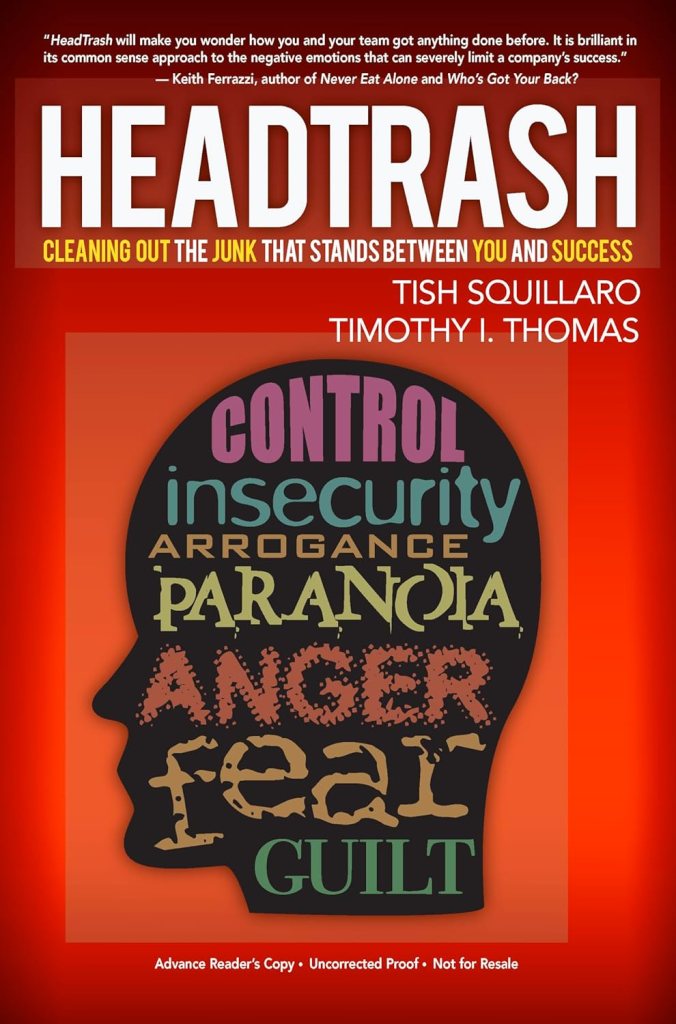
She traces most head trash back to seven emotions: fear, anger, guilt, shame, jealousy, regret and uncertainty. Having them is simply being human. The problem starts when they begin making our decisions, and fear is the biggest of them all, often disguised as caution, practicality or realism.
“Fear keeps people from taking risks. Fear keeps people from speaking up. Fear keeps people from pursuing opportunities. Fear keeps people stuck.”
The first step is awareness, and the most useful question is a simple one: is this actually true? Not every thought deserves our trust. Self-doubt does not disappear with seniority, either. The stakes get higher, and executives just become better at hiding it.
The conversations leaders avoid
The most common challenge Tish sees in leadership teams is avoidance: of difficult conversations, of conflict and of honest feedback. Avoiding a conversation does not remove the issue; it only delays it, and it usually gets worse. She describes leaders who reach the point of wanting to let someone go without ever having told that person there was a problem.
“Leadership requires honesty. People deserve to know where they stand. They deserve the opportunity to improve. They deserve clarity.”
What people struggle with most is ambiguity. When a leader goes quiet, employees fill the silence with their own stories, and those stories are rarely positive. A leader’s job, she says, is not to make everyone comfortable but to help people succeed, and that begins with self-leadership. Her role as a coach is to hold up a mirror: not what you wish were there, but what is actually there.

Success, redefined
For years, success for Tish meant proving people wrong. Today it means fulfillment, relationships and impact. She credits her husband as an incredible partner through the risks of building a business, and she still deals with head trash herself; the difference is that she recognizes it more quickly now. Travel has been one of her great teachers, less for the places than for the people and conversations, and she values Exclusive Resorts for taking the logistics away so her family can simply be present together.

Three things I took from our conversation
- Do not believe everything you think. Question the stories you tell yourself before you act on them.
- Candor is a kindness, when it is delivered well. People deserve to know where they stand, and how you say it matters as much as what you say.
- Awareness gives you choices. Without it you react; with it you can respond intentionally.
A life well-lived
For Tish, a life well-lived is one of continued growth, curiosity, meaningful relationships and a willingness to challenge yourself. Most of the limits we experience, she believes, are not external. They are internal.
“I think too many people spend their lives living within boundaries they’ve created for themselves. A life well-lived requires courage. It requires stepping outside your comfort zone. It requires taking risks. It requires believing you’re capable of more.”
Thank you, Tish, for a wonderfully candid conversation on leadership, communication, personal growth and getting out of your own way.
Full transcript
Read the full transcript here
James: In today’s episode, we’re joined by Tish Squillaro, executive coach, entrepreneur, and award-winning author. As the Founder and CEO of Candor Consulting, she helps top leaders cut through the noise and build stronger teams. She’s also the co-author of the Head Trash book series, focused on overcoming self-defeating thought patterns in business and life. From launching one of the country’s first doggy daycare businesses to advising Fortune 500 companies, Tish’s career is a masterclass in resilience, adaptability, and knowing when to get out of your own way. We’ll get straight into it. Looking at your early career, you started out as an entrepreneur right after graduating from the University of Pennsylvania. What inspired that entrepreneurial direction, and how did it shape your approach to business leadership today?
Tish: Thinking back, being an entrepreneur wasn’t common. When I was in school, I learned a little bit about marketing and business, but I initially went to college to become a lawyer. I had to put myself through school, and my first job out of high school was working in a law firm. I got to see what that world was like and thought, I could do this. That was always my mantra: I could do this. How hard could it be? Getting into Penn is another story altogether. Someone once told me, “You can’t go to an Ivy League school, Tish. You’re from Brooklyn.” I said, “Oh, really?” So I worked my way in. I never take no for an answer. Once I got to Penn, I realized I didn’t even like law. At that point, I had to rethink everything because I was paying for college myself and needed to find a degree path that made sense. I started taking business classes, and I remember sitting in a marketing class where the professor said, “If you want a niche, find something that already exists and do it a little differently.” That stuck with me. I had moved to Pennsylvania from New York by myself and gotten a puppy named Barney. One day I started thinking, What happens when I get a job? Who’s going to watch the dog? I thought, I’m going to open a dog daycare and boarding business. At the time, there was a place nearby that was basically just an outdoor dog park. I thought there had to be a better version of that. I met someone at the park who seemed to have similar interests. We didn’t know each other at all. She was from Albany. I was from Brooklyn. We were both from New York, and we thought, Why not try this? Five months later, we opened Doggy World Daycare. We had no idea how to run a business. We had no training in animal care. But we loved animals. It was my first real experience betting on myself. Looking back, I think my entire life has been driven by people telling me I couldn’t do something. Whenever someone said I couldn’t, my response was always, Really? Why not?
James: That’s fantastic. How long did you do that?
Tish: Doggy World Daycare lasted about seven or eight years. Initially, I did it full-time. Eventually, we realized it wasn’t going to become the giant enterprise I had envisioned. I loved being around the animals, but I’d show up dressed like this, and my business partner would be in sweats. She’d say, “You can’t wear a dressy outfit and spend the day picking up dog poop. You need to come dressed for the job.” I finally realized maybe that lifestyle wasn’t entirely for me. I told her, “I’ll focus on the marketing and the business side.” So I built the brand, handled the business development, and eventually, after about seven years, we sold the company. Our lives had changed. She got married and had a baby. I had met my future husband. We both felt it was time for the next chapter. That’s when I transitioned into the corporate world, although I always kept the dogs in mind.
James: What was that shift like when you moved from the doggy daycare business into the corporate world and eventually into organizational development, human capital, and strategy?
Tish: Nothing about me is planned. I simply knew I needed a job. Imagine having a résumé that says University of Pennsylvania and then your first job after graduation is Doggy World Daycare. People would look at me and ask, “What happened? Couldn’t you get a job?” Back then, entrepreneurship wasn’t viewed the way it is today. Being a female entrepreneur certainly wasn’t something most people understood. I’d tell them, “No, I opened my own business.” Fortunately, someone gave me a chance. They said, “You seem very sales-oriented. Maybe you could be a recruiter.” So that’s where I started. I got into recruiting, and from there I gradually evolved into what I do today—change management, leadership development, and helping people grow. But it wasn’t easy. Without traditional corporate experience on my résumé, it was very difficult to be taken seriously.
James: What gave you your first break in that world?
Tish: I placed myself as a recruiter into a company as the Head of HR—with absolutely no HR experience whatsoever. So, be prepared. You can make almost anything happen. I took the role, and I liked it. But I’ve always been more sales-oriented. Then the company was impacted by the dot-com crash in the early 2000s. They downsized and said, “Why don’t you run sales?” I said, “I don’t know anything about sales.” Instead, I suggested something different. I said, “You still need what I provide. Why don’t you hire me on an hourly basis, and I’ll start my own business? You can use me as needed.” That was the beginning of Candor Consulting in 2000.
James: So you started consulting for them?
Tish: Exactly. They became my first client. Through that relationship, I met other companies, started selling my services, and before long I had a growing client base. At some point, I realized I never wanted another job. I loved working for myself.
James: What was a typical assignment in those early days?
Tish: Back then, it was mostly finding talent. I became very good at understanding what companies actually needed and what candidates were really telling me. There’s a listening skill involved. People often say one thing, but if you’re paying attention, you can understand what they’re truly capable of doing. I became very effective at matching talent to organizations. I also developed a strong ability to read people dynamics. I could tell when people weren’t being honest. I could tell when teams weren’t getting along. I became a mediator. I’d come into organizations and help diffuse tension and friction. Interestingly, it was often the same groups that struggled to work together—finance and sales, marketing and analytics. There were patterns. The biggest breakthrough came when I started working with international companies. Language and cultural differences often created communication challenges, and I found myself helping people simply communicate better with one another.
James: Let’s talk about the name Candor Consulting. It feels like a very intentional choice.
Tish: There’s a story behind everything. I had been in a partnership with a group of gentlemen, and when we separated, I suddenly had to create my own company almost overnight. I needed a name that represented what I actually did. Consulting firms often have names that don’t really mean anything, and I wanted something different. So I hired a marketing consultant. We sat down and talked about my work, how I approached clients, and how I interacted with people. About halfway through the meeting, she stopped me and said, “I’ve got it.” I said, “What?” She replied, “Candor.” She said, “There isn’t a thing you say that isn’t direct, upfront, and to the point. That’s who you are.” She told me I should name the company Candor Consulting. And that’s exactly what I did.
James: It certainly fits your personality.
Tish: It really does. Over the years, I’ve tried growing the company and adding more staff, but I eventually realized that what clients are really buying is me. What I offer is highly personal. If I’m not the one delivering the work, the experience isn’t the same. So I intentionally kept the business small and boutique. Candor tells people exactly what they’re going to get. And I think clients appreciate that.
James: I think they do. Today, people often sugarcoat things. They worry about how a message will land. Being candid and direct can be refreshing.
Tish: As long as it’s delivered correctly. My mother taught me something years ago that I still remember. She always said, “It’s not what you say, it’s how you say it.” As a kid, I’d roll my eyes and think, Okay, Mom. But she was right. Delivery matters. There are people who practice what I call radical candor, where they think being brutally direct means being harsh or shocking. I’m not a fan of that. That’s not what candor means to me. For me, candor means telling people what they need to know. Most organizations are filled with people telling others what they want to hear. When I’m brought in to coach a team or an executive, I tell them upfront: “Be ready. The first thirty days, you’re probably not going to love me.” I’m going to tell you things that no one else has told you. But I’m telling you because it’s for your benefit. And if you’re willing to hear that, we can do great work together. In fact, I always give people the opportunity to cancel any coaching program after thirty days. By then, they’ll know exactly what they’re getting. What you see is what you get.
James: I like that.
Tish: That’s right.
James: One of the concepts you’re best known for is Head Trash. Tell us what that means and where the idea originated.
Tish: The concept came directly from the work I was doing with leaders and teams. I kept seeing the same pattern. People weren’t being held back by a lack of intelligence, experience, or capability. They were being held back by what was happening inside their own heads. They had stories they were telling themselves. They had assumptions. They had fears. They had beliefs that weren’t necessarily true, but those beliefs were influencing their behavior. I started calling it head trash because that’s exactly what it felt like. It’s all the negative thoughts, limiting beliefs, and emotional baggage that prevent us from becoming who we’re capable of being.
James: Was there a specific moment when you realized this was bigger than individual coaching engagements?
Tish: Yes. I kept seeing the same issues over and over again, regardless of industry, role, gender, or age. Different people. Different companies. Same challenges. Someone would say, “I’m not good enough.” Someone else would say, “I’m afraid to speak up.” Someone else would say, “What if I fail?” Someone else would say, “I’m not qualified.” The details changed, but the underlying emotions were remarkably similar. That’s when I realized there was a framework behind all of this.
James: And that’s what eventually became the book?
Tish: Exactly. The more I studied human behavior, the more I realized that most of our head trash comes from a handful of core emotions. Those emotions influence our decisions, our relationships, our leadership, and our ability to perform. When people understand what’s driving their behavior, they can begin to change it.
James: What are those emotions?
Tish: There are seven primary emotions we focus on. Fear. Anger. Guilt. Shame. Jealousy. Regret. And uncertainty. Most people experience all of them at different points in their lives. The problem isn’t having those emotions. We’re human. The problem is when those emotions begin controlling our decisions.
James: Let’s talk about fear because it seems to show up everywhere.
Tish: Fear is probably the biggest one. Fear keeps people from taking risks. Fear keeps people from speaking up. Fear keeps people from pursuing opportunities. Fear keeps people stuck. What’s interesting is that many people don’t even recognize fear when it’s showing up. They’ll call it caution. They’ll call it practicality. They’ll call it realism. But underneath it all, it’s often fear.
James: How do you help someone move through that?
Tish: The first step is awareness. You have to recognize what’s happening. Most people operate on autopilot. They have a thought, and they immediately believe it. They never stop to question it. One of the most powerful things we can do is ask ourselves: “Is this actually true?” Not every thought deserves our trust. Just because we think something doesn’t make it a fact. When people learn to separate thoughts from reality, everything begins to change.
James: That’s a simple idea, but it’s powerful.
Tish: It’s incredibly powerful. Think about how many opportunities people miss because of assumptions. Someone assumes they’re not qualified. Someone assumes they’ll fail. Someone assumes another person won’t support them. And because of those assumptions, they never take action. They never even give themselves a chance.
James: Do you see this at all levels of leadership?
Tish: Absolutely. In fact, some of the most successful people I’ve coached struggle with head trash just as much as anyone else. People assume that once you’ve reached a certain level, self-doubt disappears. It doesn’t. The stakes simply get higher. The decisions become bigger. The visibility increases. Many executives carry tremendous pressure and uncertainty. They just become better at hiding it.
James: That’s probably reassuring for people to hear.
Tish: It should be. We’re all human. The goal isn’t to eliminate fear or uncertainty. The goal is to recognize them and keep moving forward anyway. That’s where growth happens.
James: You’ve coached executives, founders, and leadership teams for years. What’s the most common challenge you encounter?
Tish: Avoidance. People avoid difficult conversations. They avoid conflict. They avoid giving honest feedback. They avoid addressing problems directly. And the longer they avoid those things, the bigger the problems become. I always tell leaders that avoiding a conversation doesn’t eliminate the issue. It simply delays it. Usually, by the time they finally address it, the situation has become much worse.
James: Why do people avoid those conversations?
Tish: Fear. It almost always comes back to fear. They’re afraid of hurting someone’s feelings. They’re afraid of creating tension. They’re afraid of being disliked. They’re afraid of getting an emotional reaction. So they stay quiet. The irony is that avoiding the conversation often creates the very outcome they’re trying to prevent.
James: Can you give an example?
Tish: Certainly. I’ll work with leaders who have an employee who’s underperforming. Everyone knows it. The team knows it. The leader knows it. The employee probably knows it. But nobody says anything. Months go by. Sometimes years go by. Then one day the leader finally reaches a breaking point and wants to terminate the person. At that point I ask, “Have you ever actually told them there’s a problem?” Often the answer is no. That’s not leadership. Leadership requires honesty. People deserve to know where they stand. They deserve the opportunity to improve. They deserve clarity.
James: That takes courage.
Tish: It does. But courage is a leadership requirement. One of the things I tell leaders is that your job isn’t to make everyone comfortable. Your job is to help people succeed. Sometimes success requires difficult conversations. Sometimes it requires accountability. Sometimes it requires hearing things you’d rather not hear. That’s part of growth.
James: Do people generally respond well when they finally receive honest feedback?
Tish: More often than not, yes. Not always in the moment. Sometimes people get defensive. Sometimes they’re surprised. Sometimes they’re upset. But over time, most people appreciate honesty. What people struggle with is ambiguity. When leaders aren’t clear, employees create their own stories. And those stories are often worse than reality.
James: That’s interesting.
Tish: Think about it. If your boss suddenly stops communicating with you, what happens? Most people immediately assume something is wrong. They start creating stories in their heads. They wonder if they’re in trouble. They wonder if they’re being judged. They wonder if they’re about to lose their job. Very rarely do people create positive stories. That’s why communication matters so much.
James: You often talk about self-awareness as a leadership skill. Why is it so important?
Tish: Because leadership starts with self-leadership. If you don’t understand your own behaviors, emotions, triggers, and blind spots, it’s very difficult to lead other people effectively. Many leaders spend all their time trying to manage others. Very few spend enough time managing themselves. Self-awareness is the foundation. Without it, growth becomes extremely difficult.
James: How do people develop greater self-awareness?
Tish: Feedback. Reflection. Curiosity. And a willingness to hear things that may be uncomfortable. One of the reasons coaching works is that it creates a mirror. I often tell clients, “My job is to hold up a mirror and help you see what’s there.” Not what you wish were there. Not what other people tell you is there. What’s actually there. That’s where real change begins.
James: That sounds uncomfortable.
Tish: Sometimes it is. Growth is often uncomfortable. But discomfort isn’t the enemy. Stagnation is. If we’re not willing to challenge ourselves, we’re unlikely to improve. And improvement is really what leadership is all about.
James: We’ve talked a lot about leadership and helping other people grow, but I’d love to talk about your own journey. How has your definition of success changed over the years?
Tish: It’s changed dramatically. When I was younger, success was tied to achievement. It was tied to proving people wrong. It was tied to accomplishment, recognition, and building something meaningful. A lot of that came from my upbringing. I was constantly hearing what I couldn’t do. So success became about showing people that I could. As I’ve gotten older, I’ve realized that success is much more personal than that. Today, success is about fulfillment. It’s about relationships. It’s about impact. It’s about waking up in the morning and feeling like I’m doing work that matters.
James: Do you think that’s a common evolution?
Tish: I do. I think many people spend the first half of their lives chasing success and the second half trying to define what success actually means. The answer is different for everyone. At some point, you realize that external validation isn’t enough. You have to decide what truly matters to you.
James: Family seems to be a big part of that for you.
Tish: Absolutely. My husband has been an incredible partner throughout this journey. Entrepreneurship isn’t easy. Building a business isn’t easy. There are sacrifices involved. There are risks involved. There are moments when things don’t go according to plan. Having someone who believes in you and supports you through all of that is incredibly important. I’ve been very fortunate in that regard.
James: What have relationships taught you?
Tish: That communication matters. Most relationship challenges come down to communication. People assume. People avoid conversations. People make up stories. People expect others to read their minds. And then they’re surprised when things don’t work out. Whether it’s a marriage, a friendship, or a business partnership, communication is everything.
James: That seems consistent with everything you’ve taught professionally.
Tish: Because it’s true everywhere. Human beings are human beings. The same dynamics that show up in organizations show up at home. The same fears show up. The same insecurities show up. The same communication challenges show up. The setting changes, but the principles remain remarkably consistent.
James: What’s the biggest lesson you’ve learned about personal growth?
Tish: That growth never ends. I think people reach a certain point and assume they’re finished. They think, I’ve achieved success. I’ve figured it out. But life has a way of continuing to teach us lessons. If we’re paying attention, we’re always learning. We’re always evolving. We’re always uncovering new layers of ourselves. That’s one of the things I love most about coaching. I’m helping other people grow, but they’re constantly teaching me as well.
James: Do you still experience head trash yourself?
Tish: Of course. Anyone who tells you they don’t is probably lying. The difference is that I recognize it more quickly now. I can identify the story I’m telling myself. I can challenge it. I can question whether it’s true. That doesn’t mean it disappears. It just means it doesn’t control me the way it once did.
James: That’s a powerful distinction.
Tish: It really is. The goal isn’t perfection. The goal is awareness. Once you’re aware of something, you have choices. Without awareness, you’re simply reacting. With awareness, you can respond intentionally. That’s where personal growth begins.
James: What role has gratitude played in your life?
Tish: A huge role. The older I get, the more grateful I become. Grateful for opportunities. Grateful for relationships. Grateful for lessons, even the difficult ones. Some of the hardest experiences in my life ultimately became some of the most valuable. I don’t know that I would’ve said that in the moment, but I can certainly say it now. Perspective changes everything.
James: Travel has been a recurring theme throughout many of these conversations because it has such a profound impact on how we see the world. What has travel meant to you personally?
Tish: Travel has been one of the greatest teachers in my life. When you travel, you realize how many different ways there are to live, think, communicate, and experience the world. It broadens your perspective. It challenges assumptions. It helps you become more open-minded. I think one of the reasons I enjoy working with people so much is because I’ve always been fascinated by how differently people think and experience life. Travel reinforces that.
James: Has there been a destination or experience that particularly shaped you?
Tish: I don’t know that there’s one destination. For me, it’s more about the people and the experiences. The places are wonderful, but it’s the conversations, the relationships, and the moments that stay with me. Those are the things I remember most. That’s true whether I’m traveling internationally or spending time somewhere close to home.
James: What has Exclusive Resorts meant to you and your family?
Tish: It’s created experiences we might not have had otherwise. One of the things I appreciate most is that it removes so much of the complexity from travel. You can focus on being present. You can focus on the people you’re with. You can focus on creating memories. That’s incredibly valuable. So often, vacations become stressful because people are managing logistics. When those things are taken care of, you can actually enjoy the experience. That’s been one of the greatest benefits for us.
James: That’s certainly something we strive for. When you think about all the work you’ve done helping leaders and organizations grow, what are you most proud of?
Tish: The people. Without question. The people I’ve helped. The lives I’ve impacted. The leaders who’ve gained confidence. The teams that learned how to communicate more effectively. The individuals who stopped holding themselves back. Those are the moments that matter. Businesses come and go. Titles come and go. But helping someone realize they’re capable of more than they believed—that’s meaningful.
James: That’s a wonderful answer.
Tish: It’s the truth. When I look back, I don’t think about contracts or revenue. I think about people. I think about conversations. I think about breakthroughs. Those are the things that stay with me.
James: How do you define a life well-lived?
Tish: A life well-lived is a life where you’ve continued to grow. It’s a life where you’ve stayed curious. It’s a life where you’ve built meaningful relationships. It’s a life where you’ve contributed something positive. And it’s a life where you’ve been willing to challenge yourself. I think too many people spend their lives living within boundaries they’ve created for themselves. A life well-lived requires courage. It requires stepping outside your comfort zone. It requires taking risks. It requires believing you’re capable of more. That’s certainly been true in my own life.
James: That’s a fitting message given everything we’ve discussed today.
Tish: I think so. If there’s one thing I’d want people to remember, it’s this: Don’t believe everything you think. Question the stories you tell yourself. Challenge the assumptions that hold you back. Most of the limits we experience aren’t external. They’re internal. And once you begin addressing that head trash, remarkable things become possible.
James: That’s a fantastic place to end. Tish, thank you for joining us today. You’ve shared incredible insights on leadership, communication, personal growth, entrepreneurship, and overcoming the stories we tell ourselves. I’ve thoroughly enjoyed our conversation.
Tish: Thank you, James. I’ve enjoyed it as well. It’s been a pleasure.
James: Thank you for joining us for this episode of A Life Well-Lived. We’ll see you next time.
A Life Well-Lived is the podcast from Exclusive Resorts, featuring the extraordinary lives of our Members and friends of the Club. Watch the full episode on YouTube, or listen on Spotify and Apple Podcasts.
Enjoyed this? Get new stories by email.
Travel, cars, aviation and conversations from A Life Well-Lived, delivered when each new post is published.
Related Posts

A Life Well-Lived: Chase Carey on Building Formula 1 into a Global Powerhouse
Recorded live at the Las Vegas Grand…

A Life Well-Lived: Dick Monfort on Ownership, Stewardship and the Colorado Rockies
At Coors Field with Colorado Rockies…
A Life Well-Lived: Jean Case on Courage, Curiosity and Making Big Bets
Tech pioneer, philanthropist,…